 |

|
|
University of Maryland researchers at AIAA SciTech (From left to right: Kasra Torshizi, Jacob Safeer, Ryan Lowe, Donald “Bucket” Costello) |
|
University of Maryland (UMD) MATRIX Lab researchers are proving that real-world challenges can be solved with cost effective research that efficiently uses resources.
MATRIX Lab graduate students Ryan Lowe (M.Eng. ’26, Robotics) and Jacob Safeer (M.S. ’26, Aerospace Engineering) and UMD Computer Science PhD student Kasra Torshizi are working with the lab's Director of Test and Evaluation of Autonomous Systems, Dr. Donald "Bucket" Costello, on ways to address various autonomy challenges in the MATRIX Lab's Omni-Domain Autonomous Systems Integration Space (OASIS). Ryan's research investigates how computer vision based on artificial intelligence can allow a drone to refuel autonomously in the air without human intervention. Jacob is researching how to make it easier for autonomous aircraft to safely and reliably land on ships, even when GPS or radio signals are unavailable. Kasra is developing a reliable and safe method for landing drones on ships in turbulent conditions.
These researchers recently presented their work at the AIAA SciTech Forum, which explores the science, technologies, and capabilities currently transforming the aerospace industry. This year's event was held last month in Orlando, Florida and serves as an opportunity to gather ideas to refine research.
Saving Time and Money While Training
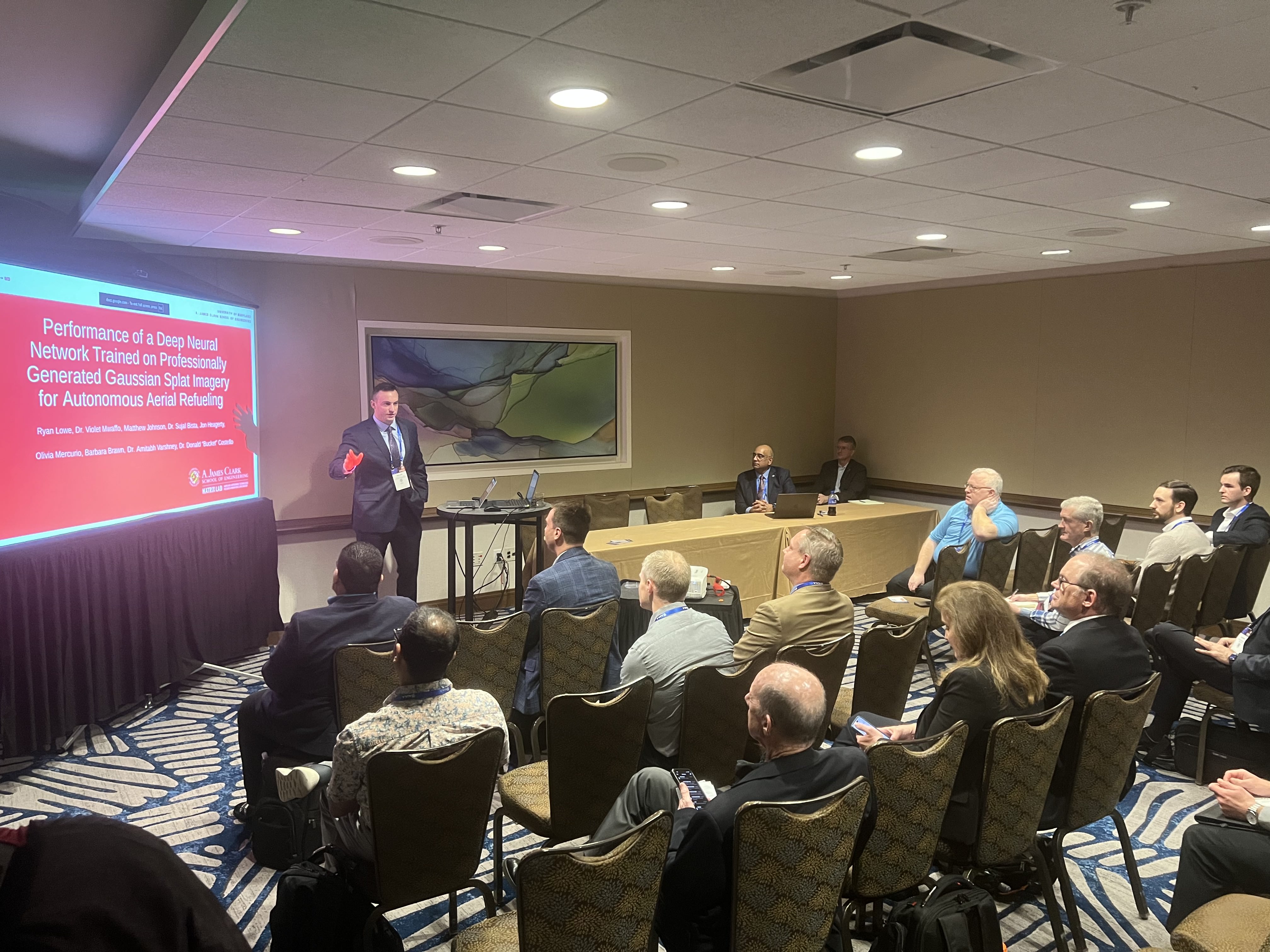 At SciTech, Ryan presented two papers. In Ryan's first presentation, he outlined how his team used realistic, computer-generated imagery to train a machine learning algorithm for detecting a drogue, which is a device towed behind a boat, or in this case, an aircraft, to slow it down. In coordination with the UMD Institute for Health Computing, he was able to demonstrate that a machine learning algorithm trained on synthetic data performed on par with one trained on actual flight test data. This demonstrated the tremendous cost savings of using synthetic data to train machine learning algorithms compared to the resource intensive practice of actual flight test. Ryan is also helping the system operate in the real world by enabling it with AI to detect the refueling basket and estimate how far away it is. His second presentation shared data showing that his computer vision-based machine learning algorithm could accurately determine the range to the aerial refueling drogue at both close and long range. Accurately determining these distances is critical for safe aerial refueling, and Ryan's research demonstrates that utilizing AI could make autonomous aerial refueling more reliable and practical for future naval operations. At SciTech, Ryan presented two papers. In Ryan's first presentation, he outlined how his team used realistic, computer-generated imagery to train a machine learning algorithm for detecting a drogue, which is a device towed behind a boat, or in this case, an aircraft, to slow it down. In coordination with the UMD Institute for Health Computing, he was able to demonstrate that a machine learning algorithm trained on synthetic data performed on par with one trained on actual flight test data. This demonstrated the tremendous cost savings of using synthetic data to train machine learning algorithms compared to the resource intensive practice of actual flight test. Ryan is also helping the system operate in the real world by enabling it with AI to detect the refueling basket and estimate how far away it is. His second presentation shared data showing that his computer vision-based machine learning algorithm could accurately determine the range to the aerial refueling drogue at both close and long range. Accurately determining these distances is critical for safe aerial refueling, and Ryan's research demonstrates that utilizing AI could make autonomous aerial refueling more reliable and practical for future naval operations.
Seamless Transitions from Simulation to Real-World
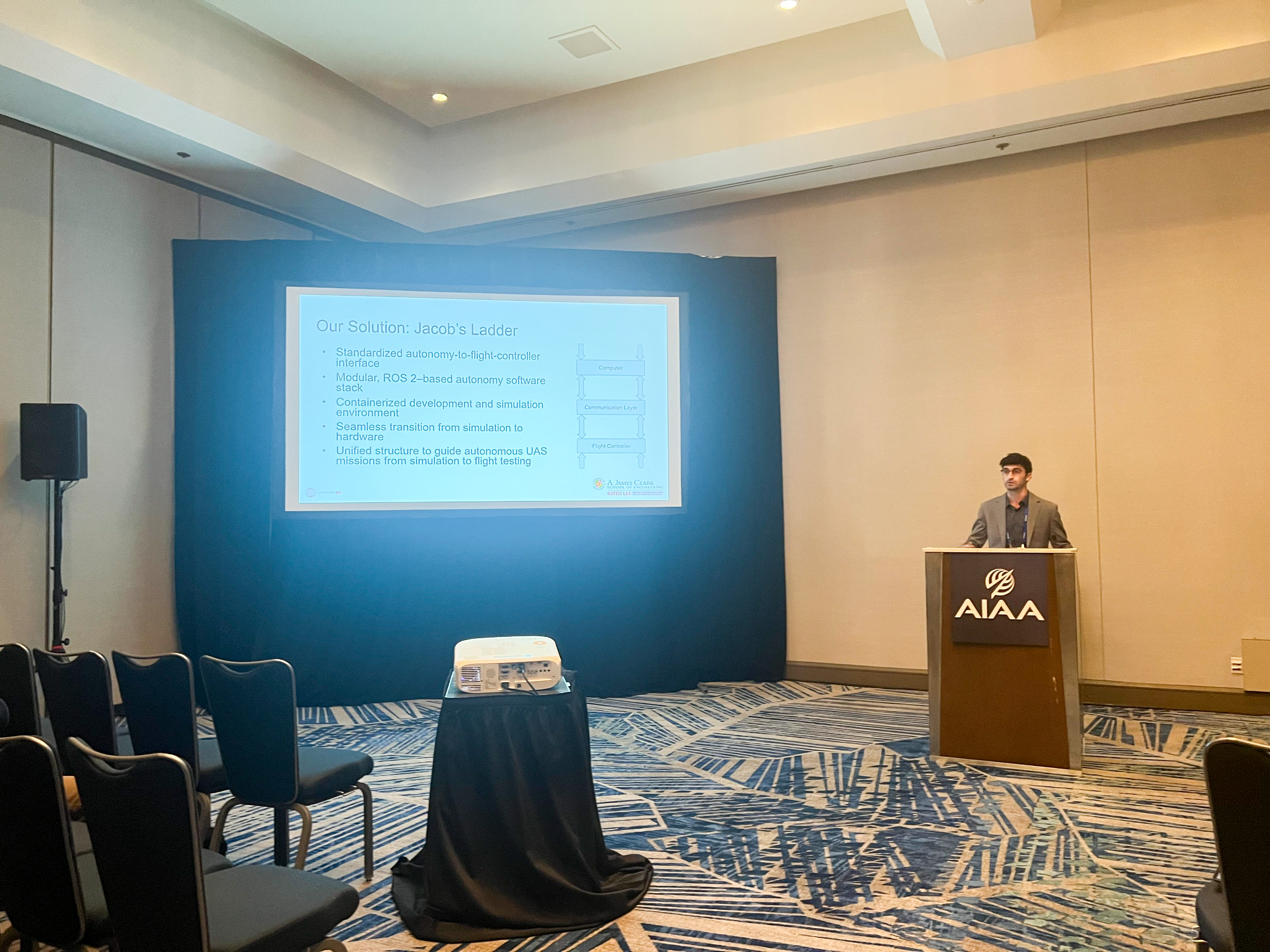
Jacob presented his work toward a consistent and flexible way for researchers to incorporate and evaluate alternative navigation and perception systems when GPS and radio signals cannot be used. His standardized system helps different parts of an autonomous drone work together more smoothly, enabling a seamless transition from simulation to hardware. This improves consistency, reduces development time and cost, and supports more scalable and repeatable testing. His research brings autonomous shipboard landings closer to practical use in challenging and contested environments.
Replicating Real-World Conditions
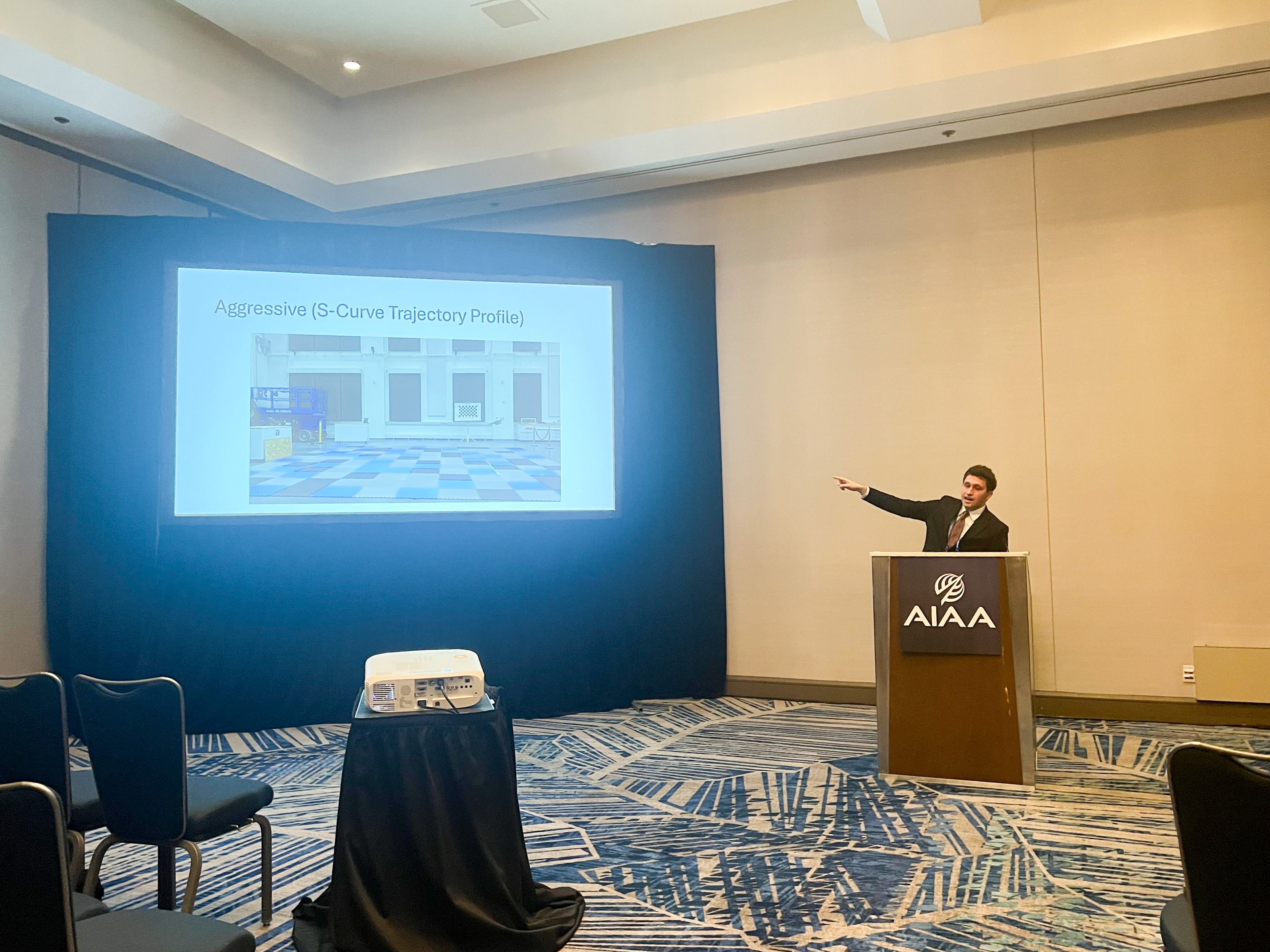 The core message of Kasra's presentation was to highlight the experimental capabilities of the MATRIX Lab's OASIS in drone research. He wanted to practice autonomous precision drone landings in windy maritime environments, so his team built a lab setup that replicates the turbulent airflow in a ship's wake. They specifically modeled their layout after the wind flows behind a Navy Yard Patrol craft, where they ultimately aim to autonomously land the drone on the flight deck. The Vicon Vantage motion capture camera system in the OASIS allowed Kasra to track his flights and collect data to quantify how increasing wind speed influences the vehicle's trajectory and landing performance. The core message of Kasra's presentation was to highlight the experimental capabilities of the MATRIX Lab's OASIS in drone research. He wanted to practice autonomous precision drone landings in windy maritime environments, so his team built a lab setup that replicates the turbulent airflow in a ship's wake. They specifically modeled their layout after the wind flows behind a Navy Yard Patrol craft, where they ultimately aim to autonomously land the drone on the flight deck. The Vicon Vantage motion capture camera system in the OASIS allowed Kasra to track his flights and collect data to quantify how increasing wind speed influences the vehicle's trajectory and landing performance.
Ryan and Jacob will continue their work in the MATRIX Lab until their graduation in May, when Ryan will report to Navy flight school in Pensacola, and Jacob will start a job with the Johns Hopkins University Applied Physics Laboratory. Kasra will continue pursuing his PhD under the mentorship of Associate Professor Pratap Tokekar (Computer Science) and Dr. Costello.
Related Articles:
MATRIX Faculty to Present at International Conference
MATRIX Lab Hiring Research Development Director
MATRIX-Affiliated Faculty Solving Tomorrow's Challenges Today
Department Welcomes New Faculty Member Tam Nguyen
Wereley, Choi Honored with Outstanding Technical Paper Award at CAMX 2024
Six Clark School Faculty Receive 2024 DURIP Awards
Maryland Engineers Awarded Grants to Address Humanity's Grand Challenges
MATRIX Lab Workshop Focuses on Fielding Autonomous Systems
Hypersonics: The Next Level
Dylan Hurlock Receives Wings Club Foundation Scholarship
February 24, 2026
|




